World Language Resources
World Language Resources Chat Live 9AM - 6PM PST Mon. - Fri.
Live chat by BoldChat
Live chat by Worldlanguage
Super Bargains
$5 Bargain Pages
Computers / Notebooks
Dictionary
ESL-English as Second Language
Games
Gift Items!
Handheld Dictionary
Keyboard Stickers
Keyboards
Kids
Learn
Microsoft Office
Microsoft Windows
Movies/Videos
Software - Mac
Software - Windows
Spell Checking
Translation
Travel Packs
More...More...
Gaelic Language

Some Suggested Products in Gaelic

Language-30 Irish Learning Audio Tape
Language-30-Irish-Learning-Audio-Tape-IrishLanguage-Gaelic-Tutorial-533 Special Price
$30.00

Regular Price
$40.95

Add to Cart Buy Product InfoInfo

Two audio cassettes (approximately 100 minutes) and verbatim pharse book. Basic conversational pharse including: greetings, personal needs, transportation, business, health and emergency terms, and more. Native voices with authentic pronunciation.
Talk More! Scots Gaelic
Talk-More-Scots-Gaelic-Learn-108582 Special Price
$45.00

Regular Price
$59.00

Add to Cart Buy Product InfoInfo

Talk More! continues the Talk Now! series using broadcast quality video and the latest interactive techniques in a software package that is ideal for travellers, holiday makers, business people, students and families. The software uses the...

Products  Introduction  Writing Sample  Translation 

Products


Introduction


Gaelic is spoken both in Ireland and in Scotland, in two distinct varieties that are generally referred to as Irish Gaelic and Scottish Gaelic. Like Welsh, it is one of the Celtic languages and thus part of the Indo-European family. Gaelic is also sometimes referred to as Erse.

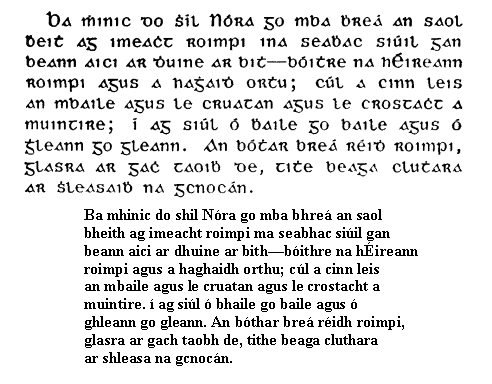
Irish Gaelic, often known simply as Irish, is an official language of the Republic of Ireland. Although spoken by only one million people, or about one-third of the population, its use has been strongly encouraged by the government and it is taught in all Irish schools. The traditional Gaelic alphabet, the first of the two samples below, was evolved from the Latin about the 5th century. it contains only five vowels and thirteen consonants-the letters i, k, q, v, ~ x, j~, and z are missing. An acute accent over a vowel indicates that it should be pronounced long, where a single dot over a consonant indicates that it should be aspirated. Nowadays Gaelic is generally written in modern English characters. In the new orthography the dot was dropped and the letter h placed after the consonant instead (e.g., ç became ch).

About the 5th century Gaelic was carried from Ireland to Scotland. With the passage of time the Scottish variety diverged to the point where it was clearly a separate dialect. Unlike Irish Gaelic, however, Scotti~h Gaelic has no official status and is spoken by only 75,000 people, or l ½ percent of the population of Scotland. Scottish Gaelic frequently uses a grave accent where Jrish uses an acute.

English words of Gaelic origin include hard, glen, bog, slogan, whiskey, blarney, shillelagh, shamrock, colleen, brogoc, and galore. Specifically Scottish Gaelic are clan, loch, and ptarmiigan.


Gaelic is spoken/used in the following countries:
Ireland, Scotland (U.K.).

Language Family
Family: Indo-European
Subgroup: Celtic
Branch: Goidelic


Copyright © Kenneth Katzner, The Languages of the World, Published by Routledge.


Writing Sample


Translation


Several times before N)rn had thought of what a fine life she would have as a tramp, independent of everybody! Her face on the roads of Ireland before her, and her back on home and the hardship and anger of her family! To walk from village to village and from glen to glen, the fine level road before her, with green fields on both sides of her and small well-sheltered houses on the mountain slopcs around her!

—PADRAIC PEARSE, The Roads