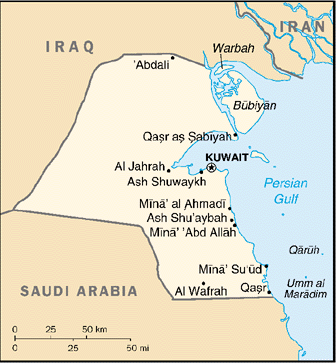
Location: Middle East, bordering the Persian Gulf, between Iraq and Saudi Arabia
Geographic coordinates: 29 30 N, 45 45 E
Map references: Middle East
Area:
total : 17,820 sq km
land: 17,820 sq km
water: 0 sq km
Area - comparative: slightly smaller than New Jersey
Land boundaries:
total: 464 km
border countries: Iraq 242 km, Saudi Arabia 222 km
Coastline: 499 km
Maritime claims:
territorial sea: 12 nm
Climate: dry desert; intensely hot summers; short, cool winters
Terrain: flat to slightly undulating desert plain
Elevation extremes:
lowest point: Persian Gulf 0 m
highest point : unnamed location 306 m
Natural resources: petroleum, fish, shrimp, natural gas
Land use:
arable land: 0%
permanent crops: 0%
permanent pastures : 8%
forests and woodland: 0%
other: 92% (1998 est.)
Irrigated land: 60 sq km (1998 est.)
Natural hazards: sudden cloudbursts are common from October to April, they bring inordinate amounts of rain which can damage roads and houses; sandstorms and dust storms occur throughout the year, but are most common between March and August
Environment - current issues: limited natural fresh water resources; some of world's largest and most sophisticated desalination facilities provide much of the water; air and water
pollution; desertification
Environment - international agreements:
party to: Climate Change, Environmental Modification, Hazardous Wastes, Law of the Sea, Nuclear Test Ban, Ozone Layer Protection
signed, but not ratified: Biodiversity, Desertification, Endangered Species, Marine Dumping
Geography - note: strategic location at head of Persian Gulf
Population: 2,111,561
note: includes 1,159,913 non-nationals (July 2002 est.)
Age structure:
0-14 years: 28.3% (male 304,200; female 292,900)
15-64 years : 69.2% (male 934,115; female 527,331)
65 years and over: 2.5% (male 34,106; female 18,909) (2002 est.)
Population growth rate: 3.33%
note : this rate reflects the continued post-Gulf crisis return of expatriates
Birth rate: 21.84 births/1,000 population (2002 est.)
Death rate: 2.46 deaths/1,000 population (2002 est.)
Net migration rate: 13.88 migrant(s)/1,000 population (2002 est.)
Sex ratio:
at birth: 1.04 male(s)/female
under 15 years: 1.04 male(s)/female
15-64 years: 1.77 male(s)/female
65 years and over: 1.8 male(s)/female
total population : 1.52 male(s)/female (2002 est.)
Infant mortality rate: 10.87 deaths/1,000 live births (2002 est.)
Life expectancy at birth:
total population: 76.46 years
male: 76.46 years
female: 77.39 years (2002 est.)
Total fertility rate: 3.14 children born/woman (2002 est.)
Nationality:
noun: Kuwaiti(s)
adjective: Kuwaiti
Ethnic groups:Kuwaiti 45%, other Arab 35%, South Asian 9%, Iranian 4%, other 7%
Religions: Muslim 85% (Shi'a 30%, Sunni 45%, other 10%), Christian, Hindu, Parsi, and other 15%
Languages: Arabic (official), English widely spoken
Literacy:
definition: age 15 and over can read and write
total population: 78.6%
male : 82.2%
female: 74.9% (1995 est.)
Country name:
conventional long form : State of Kuwait
conventional short form: Kuwait
local long form: Dawlat al Kuwayt
local short form: Al Kuwayt
Data code: KU
Government type: nominal constitutional monarchy
National capital: Kuwait
Administrative divisions: 5 governorates (muhafazat, singular - muhafazah); Al Ahmadi, Al Jahrah, Al Kuwayt, Hawalli, Al Farwaniyah
Independence: 19 June 1961 (from UK)
National holiday: National Day, 25 February (1950)
Constitution: approved and promulgated 11 November 1962
Legal system: civil law system with Islamic law significant in personal matters; has not accepted compulsory ICJ jurisdiction
Suffrage: adult males who have been naturalized for 30 years or more or have resided in Kuwait since before 1920 and t heir male descendants at age 21
note: only 10% of all citizens are eligible to vote; in 1996, naturalized citizens who do not meet the pre-1920 qualification but have been naturalized for 30 years were eligible to vote for the first time
Executive branch:
chief of state:Amir JABIR al-Ahmad al-Jabir Al Sabah (since 31 December 1977)
head of government:Prime Minister and Crown Prince SAAD al-Abdallah al-Salim Al Sabah (since 8 February 1978); First Deputy Prime Minister SABAH al-Ahmad al-Jabir Al Sabah (since 17 October 1992); Deputy Prime Ministers JABIR MUBARAK al-Hamud Al Sabah (since NA) and MUHAMMAD KHALID al-Hamed Al Sabah (since NA)
cabinet: Council of Ministers appointed by the prime minister and approved by the amir
elections: none; the monarch is hereditary; prime minister and deputy prime ministers appointed by the monarch
Legislative branch: unicameral National Assembly or Majlis al-Umma (50 seats; members elected by popular vote to serve four-year terms)
elections :last held 3 July 1999 (next to be held NA 2003)
election results: percent of vote - NA%; seats - independents 50; note - all cabinet ministers are also ex officio members of the National Assembly
Judicial branch: High Court of Appeal
Political parties and leaders: none; formation of political parties is illegal
Political pressure groups and leaders: several political groups act as de facto parties: Bedouins, merchants, Sunni and Shi'a activists, and secular leftists and nationalists
International organization participation: ABEDA, AfDB, AFESD, AL, AMF, BDEAC, CAEU, CCC, ESCWA, FAO, G-77, GCC,
IAEA, IBRD, ICAO, ICC, ICRM, IDA, IDB, IFAD, IFC, IFRCS, ILO, IMF, IMO, Inmarsat, Intelsat, Interpol, IOC, ISO (correspondent), ITU, NAM, OAPEC, OIC, OPEC, UN, UNCTAD, UNESCO, UNIDO, UPU, WFTU, WHO, WMO, WToO, WTrO
Diplomatic representation in the US:
chief of mission: Ambassador Sheikh Salem Abdullah Al Jaber AL SABAH
chancery: 2940 Tilden Street NW, Washington, DC 20008
telephone: [1] (202) 966-0702
FAX : [1] (202) 966-0517
Diplomatic representation from the US:
chief of mission: Ambassador Richard H. JONES
embassy: Bneid al-Gar (opposite the Kuwait International Hotel), Kuwait City
mailing address: P.O. Box 77, SAFAT, 13001 SAFAT, Kuwait; Unit 6900, APO AE 09880-9000
telephone: [965] 539-5307 or 539-5308
FAX: [965] 538-0282
Flag description: three equal horizontal bands of green (top), white, and red with a black trapezoid based on the hoist side
Economy - overview: Kuwait is a small, rich, relatively open economy with proved crude oil reserves of 94 billion barrels - 10% of world reserves. Petroleum accounts for nearly half of GDP, 90% of export revenues, and 75% of government income. Kuwait's climate limits agricultural development. Consequently, with the exception of fish, it depends almost wholly on food imports. About 75% of potable water must be distilled or imported. Higher oil prices put the FY99/00 budget into a $2 billion surplus. The FY00/01 budget covers only nine months because of a change in the fiscal year. The budget for FY01/02 envisioned higher expenditures for salaries, construction, and other general categories. Kuwait continues its discussions with foreign oil companies to develop fields in the northern part of the country.
GDP: purchasing power parity - $30.9 billion (2001 est.)
GDP - real growth rate: 4% (2001 est.)
GDP - per capita: purchasing power parity - $15,100 (2001 est.)
GDP - composition by sector:
agriculture:0.3% (2000)
industry : 60%
services: 39.7%
Inflation rate - consumer price index: 2.7% (2001)
Labor force:
total: 1.3 million (1998 est.)
note: 68% of the population in the 15-64 age group is non-national (July 1998 est.)
by occupation: industry and agriculture 25%, services 25%, government and social services
50% (1994 est.)
note: 72.07% of the population in the 15-64 age group is non-national (July 1997 est.)
Unemployment rate: 1.8% (official 1996 est.)
Budget:
revenues: $11.5 billion
expenditures : $17.2 billion, including capital expenditures of $NA (FY01/02)
Industries: petroleum, petrochemicals, desalination, food processing, construction materials, salt, construction
Industrial production growth rate: 1% (1997 est.)
Electricity - capacity: 6.99 million kW (1994)
Electricity - production: 31.2 billion kWh (2000)
Electricity - consumption per capita: 29.016 billion kWh (2000)
Agriculture - products: practically no crops; extensive fishing in territorial waters
Exports:
total value: $16.2 billion (f.o.b., 2001 est.)
commodities : oil
partners: Japan 23%, US 14%, South Korea 13%, Singapore 7%, Netherlands 6%, Pakistan 6%, Indonesia 4%, UK 2% (2000)
Imports:
total value: $7.4 billion (f.o.b., 2001 est.)
commodities: food, construction materials, vehicles and parts, clothing
partners : US 12%, Japan 8%, UK 8%, Germany 7%, China 5%, France 4%, Australia 3%, Netherlands 2% (2000)
Debt - external: $6.9 billion (2000 est.)
Economic aid: $NA
Currency: 1 Kuwaiti dinar (KD) = 1,000 fils
Exchange rates: Kuwaiti dinars per US dollar - 0.3075 (January 2002), 0.3066, (2001), 0.3067 (2000), 0.3044 (1999), 0.3047 (1998), 0.3033 (1997)
Fiscal year: 1 July - 30 June
Telephones: 412,000 (1997)
Telephone system:the quality of service is excellent
domestic:new telephone exchanges provide a large capacity for new subscribers; trunk traffic is carried by microwave radio relay, coaxial cable, open wire, and fiber-optic cable; a cellular telephone system operates throughout Kuwait, and the country is well supplied with pay telephones
international:coaxial cable and microwave radio relay to Saudi Arabia; linked to Bahrain, Qatar, UAE via the Fiber-Optic Gulf (FOG) cable; satellite earth stations - 3 Intelsat (1 Atlantic Ocean, 2 Indian Ocean), 1 Inmarsat (Atlantic Ocean), and 2 Arabsat
Radio broadcast stations:AM 6, FM 11, shortwave 1 (1998)
Radios: 1.175 million (1997)
Television broadcast stations: 13 (plus several satellite channels) (1997)
Televisions: 875,000 (1997)
Railways: 0 km
Highways:
total:4,450 km
paved:3,590 km
unpaved : 860 km (1999 est.)
Pipelines: crude oil 877 km; petroleum products 40 km; natural gas 165 km
Ports and harbors: Ash Shu'aybah, Ash Shuwaykh, Kuwait, Mina' 'Abd Allah, Mina' al Ahmadi, Mina' Su'ud
Merchant marine:
total: 38 ships (1,000 GRT or over) totaling 2,274,515 GRT/3,627,835 DWT
ships by type: bulk 1, cargo 1, container 6, liquefied gas 6, livestock carrier 5, petroleum tanker 19
Airports: 7 (2001)
Airports - with paved runways:
total: 3
over 3,047 m : 1
2,438 to 3,047 m: 2 (2001)
Airports - with unpaved runways:
total: 4
under 914 m: 3 (2001)
1,524 to 2,437 m: 1
Heliports: 3 (2001)
Military branches: Army, Navy, Air Force, National Guard, Ministry of Interior Forces, Coast Guard
Military manpower - military age: 18 years of age
Military manpower - availability:
males age 15-49 : 812,059 (2002 est.)
Military manpower - fit for military service:
males: 486,906 (2002 est.)
Military manpower - reaching military age annually:
males: 18,309 (2002 est.)
Military expenditures - dollar figure: $1,967,300,000 (FY01)
Military expenditures - percent of GDP:5.5% (FY01)
Disputes - international: in November 1994, Iraq formally accepted the UN-demarcated border with Kuwait which had been spelled out in Security Council Resolutions 687 (1991), 773 (1993), and 883 (1993); this formally ends earlier claims to Kuwait and to Bubiyan and Warbah islands; ownership of Qaruh and Umm al Maradim islands disputed by Saudi Arabia
|


 Play the National Anthem